

Triassic Trees and Pueblo Houses
- Tami Srianant

- Dec 18, 2020
- 3 min read
“Traveling – it leaves you speechless, then turns you into a storyteller.” Ibn Battuta
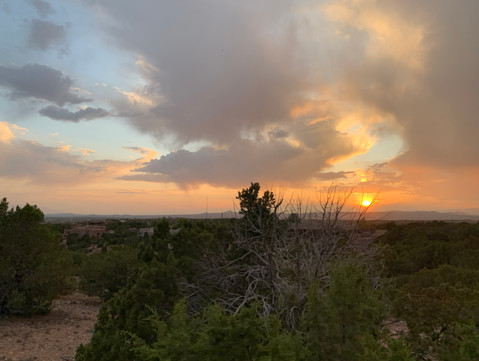
Our last journey before starting our job search began the end of September, as the fall began to usher in the cooler weather. We headed out west again, toward the quirky mountain town of Santa Fe, New Mexico. We arrived before the sun met the horizon to our west, in time to drive around town and explore the artistic creations. Unique pueblo homes dotted the streets, painting an architectural gem nestled among the mountains of northern New Mexico. We raced to the outskirts to catch the sunset rays as they lit up the storm clouds in the sky. Santa Fe literally translates to "Holy Faith," a city founded from La Villa Real de la Santa Fe de San Francisco de Asis. The Saint Francis of Assisi was known as the patron saint of animals and the natural environment: my favorite saint.
The setting sun illuminated the sky in a divine painting of our Maker's hand as we drove around the mountain streets on the outskirts of Santa Fe. We made our way back to our hotel for the evening to settle in for a long slumber before the nearly 500 mile journey ahead of us tomorrow.
Early the next morning we grabbed a socially distanced quiche and coffee at a local breakfast joint called 'dulce.' The sunshine on our skin felt like a warm hug in the crisp mountain air. We headed north to the infamous town of Los Alamos, known as the birth place of the atomic bomb. We had researched some of the best places to live in New Mexico, and Los Alamos topped the list. The drive to this small place was breathtaking. Desert mountain-scapes dappled with evergreen trees were all around. A lush green golf course sat in the middle of the town surrounded on all sides by bare mountains. It was a quiet community filled with some of the brainiest scientists in the US, but our hearts didn't feel that it was the right place for us.
Our journey took us south through the largest city in New Mexico: Albuquerque. Westbound, we drove parallel to Historic Route 66 along I-40. We stopped for lunch in El Malpais National Monument. Baby blue skies covered in puffy white clouds greeted our shaded spot near the visitors center. We ate our pre made chicken salad, Hawaiian rolls, chips and colby jack cheese out of the back of Ren. Concerned about time constraints, we weren't able to investigate the whole of the park, so we set out toward Arizona.
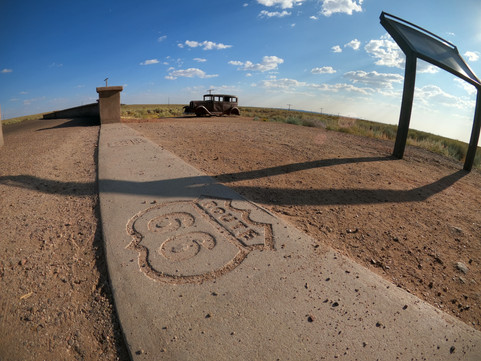
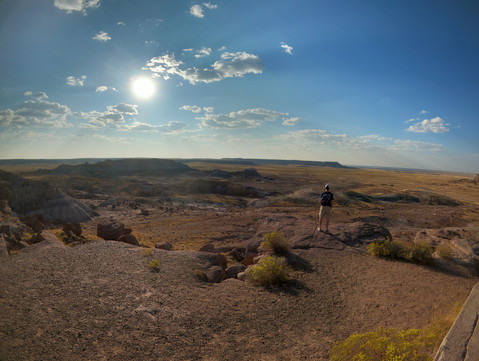
We arrived at the Petrified Forest National Park with only about two hours left to explore. The road through the entire park is 28 miles long. One of our stops was at the Painted Desert Inn, an adobe faced building that blends beautifully into the desert landscape. The sun was chasing the western horizon, illuminating the colorful desert hills and green shrubs in a golden light. The rusted shell of an old, wheelless 1932 Studebaker car sat along the telephone dotted route of Historic Route 66. Petrified Forest National Park is the only park that lies within the famous thoroughfare. Petroglyphs etched into desert rock at Newspaper Rock tell the ancient story of ancestral Pueblo families nearly 650 to 2,000 years ago.
Onward we traveled along the badland hills of bluish bentonite clay in the Blue Mesa route. Agate Bridge, one of the most famous specimens found in the park, spans a natural gully. Due to the effects of erosion and flood waters, a gully washed out beneath the petrified log, forming a bridge. But in 1911, concern about the impacts of human visitation and possible damage, caused conservationists to reinforce the tree with concrete.
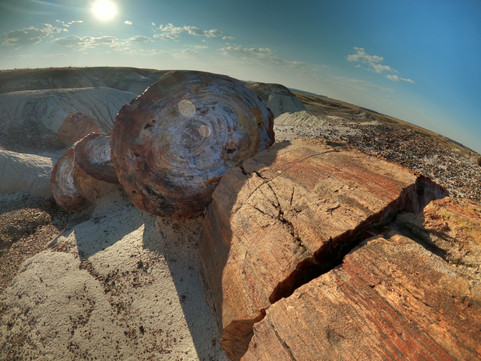
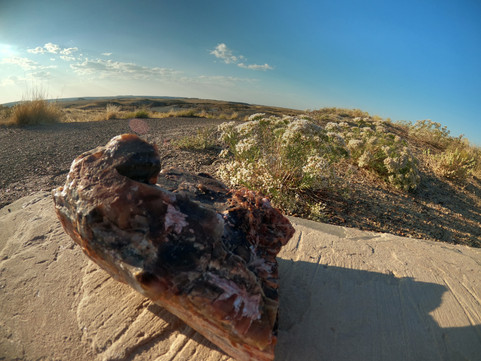
We made it to the amazingly stunning Crystal Forest with little time left to explore. Thousands of petrified wood logs lie in this ancient, preserved forest. These fossilized specimens create a marvelous time capsule from some 225 million years ago during the Late Triassic Epoch. During this time, 200 foot conifers towered high over the landscape. Late in the Triassic period, fallen trees became trapped in river channels, buried periodically by volcanic ash. Silica from the ash was dissolved by groundwater, carried into the logs, thus creating pockets where quartz crystals formed. Iron oxide and other substances combined with volcanic silica ash, replacing organic material and creating a rainbow of colors within the petrified logs. It was a hauntingly beautiful experience, walking among the triassic trees of Petrified Forest National Park.
We drove into the sunset along Route 66/I-40, racing the sun toward the horizon on our way to Flagstaff and more adventures.










Comments